
The GTX 1660 Super landed in 2019 as NVIDIA’s answer to budget-conscious gamers who wanted solid 1080p performance without very costly. Fast-forward to 2026, and this Turing-based GPU is still floating around the used market, with ASUS’s TUF Gaming variant regularly popping up on eBay, Facebook Marketplace, and local classifieds. But here’s the question nobody’s asking politely anymore: should you actually buy one?
The ASUS TUF Gaming GeForce GTX 1660 Super carved out a reputation for being a workhorse, reliable cooling, competitive pricing, and enough horsepower to handle esports titles and AAA games at respectable settings. But we’re three GPU generations deep now, with AMD and NVIDIA both fielding newer budget cards that promise better efficiency and ray tracing support. This review digs into whether the ASUS TUF Gaming 1660 Super still holds up for gaming in 2026, or if it’s time to move on.
Key Takeaways
- The ASUS TUF Gaming 1660 Super remains a solid budget option for 1080p gaming and esports titles in 2026, delivering 60-80 FPS in AAA games at Medium settings and 150+ FPS in competitive shooters.
- The card’s 6GB VRAM is its primary bottleneck in modern games, causing stuttering at Ultra texture settings, while its lack of DLSS and ray tracing support limits longevity compared to newer alternatives.
- Used ASUS TUF Gaming 1660 Super models are available for $80-120, offering exceptional value for budget builders, secondary rigs, and esports enthusiasts who prioritize affordability over cutting-edge performance.
- Excellent thermal management with the DirectCU II cooler keeps the GPU at 65-70°C under load and enables silent 0dB fan operation during light workloads, making it ideal for quiet builds.
- Buyers with budgets over $150 should consider a used RTX 2060 or new RTX 4060 instead, as these cards provide superior ray tracing, DLSS support, and 50-60% better performance for only moderately higher cost.
Overview and Specifications
The ASUS TUF Gaming GTX 1660 Super sits in the middle of ASUS’s 1660 Super lineup, not the cheapest option, but far from premium territory. It’s built on NVIDIA’s TU116 GPU, the same 12nm Turing architecture that powered the GTX 16-series before Ampere and Ada Lovelace took over.
The TUF branding signals durability over flash. ASUS markets this line toward gamers who prioritize longevity and thermal stability rather than RGB bling and overclocking headroom. It’s a practical pick, which is exactly what budget gamers needed back in 2019, and possibly still need today if they’re shopping used.
Key Technical Specifications
Here’s what you’re working with under the hood:
- GPU: NVIDIA GeForce GTX 1660 Super (TU116-300-A1)
- CUDA Cores: 1,408
- Base Clock: 1,530 MHz
- Boost Clock: 1,830 MHz (ASUS factory overclock)
- Memory: 6GB GDDR6
- Memory Interface: 192-bit
- Memory Bandwidth: 336 GB/s
- TDP: 125W
- Power Connectors: Single 8-pin PCIe
- Display Outputs: 1x HDMI 2.0b, 3x DisplayPort 1.4
- Dimensions: 204 x 130 x 52 mm (dual-slot)
- Recommended PSU: 450W
That 6GB of GDDR6 is the real differentiator from the base GTX 1660, which used GDDR5. The bandwidth bump translates into smoother frame pacing in memory-intensive titles, especially at higher texture settings. The 1,830 MHz boost clock is slightly higher than NVIDIA’s reference spec, giving the TUF variant a small edge over baseline models.
What’s in the Box?
Nothing fancy here. ASUS includes:
- The GPU itself
- A basic user manual
- A driver CD (which you’ll ignore in favor of downloading the latest drivers)
No mounting bracket, no RGB controller, no stickers. If you’re buying used, don’t expect any packaging at all, most sellers toss it years ago.
Design and Build Quality
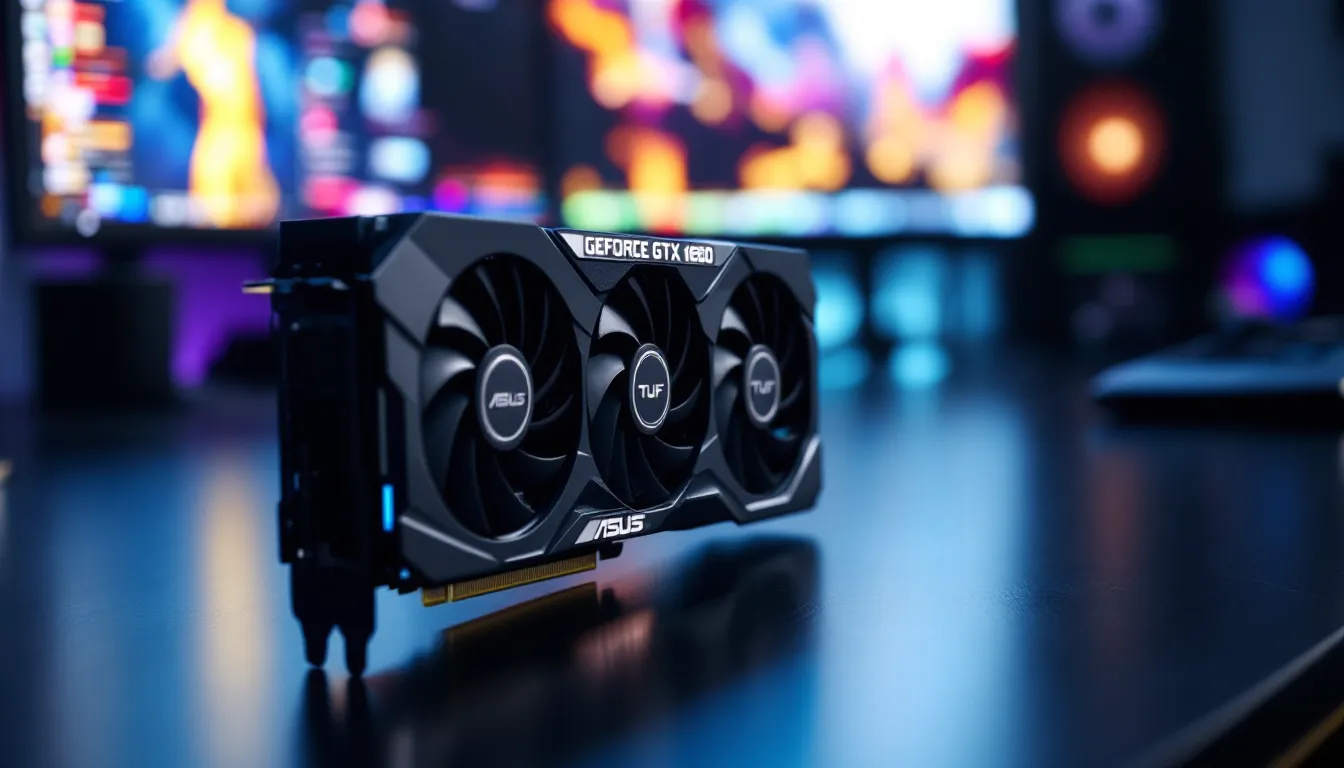
ASUS TUF cards lean heavily into the “military-grade” aesthetic, with a matte black shroud and angular lines that won’t win design awards but also won’t look dated in three years. The dual-fan cooler features two Axial-tech fans with a combined diameter that covers most of the card’s footprint.
Build quality feels solid. The backplate is metal, not flimsy plastic, and the PCB uses ASUS’s Auto-Extreme manufacturing process, automated soldering that supposedly reduces failure points. There’s no visible flex or cheap materials here, which is reassuring for a card that might pull duty in a budget rig for years.
Cooling System and Thermal Performance
The ASUS TUF Gaming 1660 Super uses a DirectCU II heatsink with two copper heat pipes making direct contact with the GPU die. The dual Axial-tech fans push air through the aluminum fin stack, and ASUS claims the fan design increases airflow by 27% compared to previous generations.
In practice, thermals are excellent. Under sustained gaming loads, the GPU settles between 65-70°C in a well-ventilated case, with fan noise staying comfortably below 40 dBA. That’s quieter than most competing models from MSI or Gigabyte at similar price points. ASUS also includes a 0dB fan mode that stops the fans entirely during light workloads or desktop use, which keeps the card silent when you’re browsing or watching streams.
The cooler is frankly overkill for a 125W TDP GPU, but that’s a feature, not a bug. Lower temps mean longer lifespan and more headroom for mild overclocking if you’re so inclined.
Aesthetics and RGB Features
There’s no RGB on the ASUS TUF Gaming 1660 Super. Zero. The only lighting is a small white TUF logo on the side that’s always on when the card is powered. If you’re building a rainbow vomit rig, this isn’t the card for you. If you prefer a cleaner, understated look, or you’re building in a case without a window, it’s perfect.
The black-and-grey color scheme pairs well with most builds, and the card is short enough (204mm) to fit in most mid-tower and even some compact cases without blocking drive cages or fan mounts.
Performance Benchmarks
Let’s get to what matters: can the ASUS TUF Gaming 1660 Super still run games in 2026, or is it a slideshow generator?
1080p Gaming Performance
The GTX 1660 Super was designed for 1080p gaming, and that’s still where it performs best. Here’s how it handles current and recent AAA titles at 1920×1080:
- Cyberpunk 2077 (v2.1): 45-50 FPS on Medium settings, no ray tracing. Drop to Low and you’ll hit 60+ FPS consistently.
- Baldur’s Gate 3: 55-65 FPS on High settings in Act 1. Expect dips to the low 40s in Act 3’s CPU-heavy areas.
- Elden Ring: 60 FPS locked on High settings with occasional drops in dense foliage.
- Starfield: 40-45 FPS on Medium settings. This game is brutally unoptimized, and the 6GB VRAM shows its age here.
- Call of Duty: Modern Warfare III (2023): 70-80 FPS on Medium-High settings in multiplayer.
- Helldivers 2: 55-65 FPS on Medium settings. Performance tanks in chaotic 4-player sessions.
Across the board, you’re looking at playable frame rates if you’re willing to dial settings back to Medium or use dynamic resolution scaling. Texture quality is where the 6GB VRAM hits a wall, Ultra textures in modern games will cause stuttering as the card swaps assets in and out of memory. Independent testing from Tom’s Hardware confirms that VRAM capacity, not raw compute power, is the 1660 Super’s biggest bottleneck in 2026.
Esports and Competitive Gaming
This is where the GTX 1660 Super still shines. Esports titles are GPU-light, and the 1660 Super has more than enough horsepower to deliver high refresh rate gaming:
- Valorant: 200+ FPS on High settings, 300+ on Low. No issues hitting 144Hz or even 240Hz monitors.
- Counter-Strike 2: 150-180 FPS on High settings. Competitive players on Low can push 250+ FPS.
- League of Legends: 200+ FPS maxed out. Zero frame drops.
- Overwatch 2: 120-140 FPS on Epic settings, 180+ on Medium.
- Apex Legends: 100-120 FPS on High settings, 144+ on Medium-Low.
If you’re primarily playing competitive shooters or MOBAs, the ASUS TUF Gaming GeForce GTX 1660 Super is still more than capable. You won’t be leaving frames on the table at 1080p, and the card’s efficiency means your system stays cool and quiet even during marathon sessions.
Content Creation and Streaming Capabilities
The GTX 1660 Super lacks the dedicated NVENC encoder found in RTX cards, relying instead on the older 6th-gen NVENC hardware. It’ll handle 1080p60 streaming to Twitch or YouTube, but quality takes a noticeable hit compared to modern cards.
For video editing, Premiere Pro and DaVinci Resolve will use the card’s CUDA cores for GPU acceleration, but render times are significantly slower than RTX 30-series or 40-series cards. If content creation is more than a side hobby, you’ll want something beefier. Benchmarks from Hardware Times show the 1660 Super lagging 40-50% behind even the budget RTX 3050 in Adobe workloads.
Power Consumption and Efficiency
The GTX 1660 Super sips power compared to modern GPUs. NVIDIA’s 12nm Turing node isn’t as efficient as TSMC’s 5nm process used in the RTX 40-series, but the lower performance ceiling keeps total system power in check.
Under full gaming load, the ASUS TUF Gaming 1660 Super pulls around 110-120W from the wall. That’s low enough to pair with a quality 450W PSU, though 550W gives you more headroom for CPU overclocking or future upgrades.
Compare that to the RTX 4060, which has a 115W TDP but often spikes higher, or AMD’s RX 7600 at 165W. If you’re running a budget build with a basic PSU or you care about electricity costs, the 1660 Super’s efficiency is a legitimate selling point. Over a year of heavy gaming, you could save $20-30 on your power bill compared to a hungrier card.
The single 8-pin PCIe connector also makes installation dead simple. No hunting for dual 8-pin cables or adapter dongles.
Comparison With Competing GPUs
ASUS TUF vs Other GTX 1660 Super Models
The GTX 1660 Super lineup includes variants from MSI, Gigabyte, EVGA, and Zotac. Here’s how the ASUS TUF stacks up:
- MSI Gaming X: Slightly higher boost clock (1,845 MHz) but noisier fans under load. About 5% better performance, but you’ll hear it.
- EVGA XC Ultra: Comparable cooling and clocks, but EVGA’s warranty service was historically better (though EVGA exited the GPU market in 2022, so this matters less for used cards).
- Gigabyte Windforce OC: Cheaper, but louder and runs 5-8°C hotter. Fine if airflow is good: risky in compact cases.
The ASUS TUF Gaming 1660 Super sits in the sweet spot: better cooling and quieter operation than budget models, without the price premium of top-tier variants. If you’re shopping used and prices are within $10-15, the TUF is the safer bet.
GTX 1660 Super vs RTX 2060 and RX 5600 XT
Back in 2019-2020, the GTX 1660 Super competed directly with the RTX 2060 and AMD’s RX 5600 XT. How do they compare today?
- RTX 2060 (6GB): About 15-20% faster in rasterization, plus it has ray tracing and DLSS support. In 2026, DLSS 2.0 gives the 2060 a meaningful edge in newer titles. If priced similarly, the 2060 is the better buy.
- RX 5600 XT: Roughly equal to the 1660 Super in most games, with slightly better performance at higher settings thanks to 6GB of faster GDDR6. AMD’s driver overhead can be a pain, though, and the card runs hotter. Toss-up depending on price.
If you’re choosing between these three on the used market, prioritize the RTX 2060 if it’s within $20 of the 1660 Super. The DLSS support alone extends its useful lifespan.
How It Stacks Up Against Modern Budget Cards in 2026
This is where things get interesting. The GPU market in 2026 has settled after years of crypto chaos and supply shortages. New budget cards include:
- RTX 4060 (8GB): MSRP around $299. About 50-60% faster than the 1660 Super, with DLSS 3.0, frame generation, and full ray tracing support. If you can afford it, this is the smarter long-term investment.
- RX 7600 (8GB): MSRP around $269. Comparable performance to the RTX 4060 in rasterization, slightly behind in ray tracing. AMD’s FSR 3.0 helps in supported titles.
- Intel Arc A750 (8GB): MSRP around $249. Competitive performance, but driver maturity is still a question mark for older games.
The ASUS TUF Gaming 1660 Super can’t compete on raw performance, but it dominates on price. Used models sell for $80-120 depending on condition and local market. Analysis from TechSpot shows the 1660 Super offering about 60-70% of the RTX 4060’s performance at roughly one-third the cost. That’s a compelling value proposition if you’re on a tight budget or building a secondary rig.
Pros and Cons
Pros:
- Excellent thermal performance: Runs cool and quiet thanks to the oversized cooler and 0dB fan mode.
- Solid 1080p gaming: Still handles esports titles at high refresh rates and AAA games at Medium settings.
- Low power consumption: Fits in budget builds with modest PSUs: single 8-pin connector keeps wiring clean.
- Used market value: Prices have dropped to $80-120, making it one of the cheapest viable 1080p cards available.
- Compact size: Fits in most cases without blocking other components.
- Reliable build quality: ASUS TUF construction and metal backplate inspire confidence for long-term use.
Cons:
- Only 6GB VRAM: Limits texture quality in modern AAA games: stuttering is common at Ultra settings.
- No ray tracing or DLSS: Lacks the features that extend GPU lifespan in 2026.
- Aging architecture: Turing is three generations old: driver support and game optimizations are winding down.
- Limited content creation performance: NVENC 6th-gen encoder and slower CUDA performance make it a weak choice for streamers and editors.
- No 1440p viability: Frame rates tank at 2560×1440, even on Low settings in demanding games.
- Driver support uncertainty: NVIDIA may drop GTX 16-series from Game Ready drivers in the next 1-2 years.
Who Should Buy the ASUS TUF Gaming 1660 Super?
The ASUS TUF Gaming 1660 Super isn’t for everyone in 2026, but there are specific scenarios where it still makes sense:
Budget-conscious gamers: If your total GPU budget is under $150 and you’re primarily playing esports titles or older AAA games, the 1660 Super delivers excellent value on the used market. You’re not getting cutting-edge performance, but you are getting playable frame rates at 1080p.
Secondary or LAN rig builders: Building a couch co-op machine, a PC for the kids, or a portable LAN rig? The 1660 Super’s low power draw, compact size, and reliability make it a smart pick for systems that don’t need to run Cyberpunk at max settings.
Esports enthusiasts: If Valorant, CS2, League of Legends, or Overwatch 2 are your main games, the 1660 Super still crushes high refresh rate gaming. You’re not leaving frames on the table at 1080p, and you can snag one for less than the cost of a new AAA game.
Upgraders from integrated graphics: If you’re running an APU or ancient GPU and need a quick, affordable jump to dedicated graphics, the 1660 Super is a massive upgrade that won’t strain your PSU or require a case swap.
Who should skip it:
- Anyone planning to game at 1440p or 4K
- Content creators who stream or edit video regularly
- Gamers who want ray tracing or DLSS support
- Anyone with a budget over $200, at that point, a used RTX 2060 or new RTX 4060 offers better long-term value
Where to Buy and Pricing Guide
New ASUS TUF Gaming GeForce GTX 1660 Super cards are essentially extinct in 2026. NVIDIA stopped production years ago, and retailers cleared out remaining stock long before now. Your only realistic option is the used market.
Used market pricing (as of March 2026):
- eBay: $90-130 depending on condition and seller rating. Watch for auction listings: you can sometimes snag one for under $80 if you’re patient.
- Facebook Marketplace / Craigslist: $80-110. Prices vary wildly by region. Urban markets tend to have more inventory and competitive pricing.
- r/hardwareswap (Reddit): $85-120. Community-vetted sellers reduce scam risk, but inventory moves fast.
- Local PC shops: $100-140. You’re paying a premium for peace of mind and potential warranty, but selection is hit-or-miss.
Buying tips:
- Ask for photos of the card running GPU-Z or similar monitoring software to verify it’s not a fake or flashed BIOS.
- Check the fan bearings, spin them gently by hand. Any grinding or resistance is a red flag.
- Request a brief stress test video (FurMark or Heaven Benchmark) to confirm thermal performance.
- Factor in shipping costs on eBay: local pickup saves $10-15 and lets you inspect the card in person.
- Don’t pay more than $120 unless it’s like-new with original packaging and you’re in a low-inventory area.
If you can’t find a TUF variant, the MSI Gaming X and EVGA XC Ultra are solid alternatives at similar price points.
Installation and Setup Tips
Installing the ASUS TUF Gaming 1660 Super is straightforward, but here’s how to avoid common pitfalls:
Physical installation:
- Power down the system completely and flip the PSU switch to off.
- Remove the side panel and locate the top PCIe x16 slot (the one closest to the CPU).
- Remove the two rear slot covers, you’ll need both for the dual-slot card.
- Align the card with the PCIe slot and press down firmly until the retention clip clicks.
- Secure the card to the case with screws through the rear bracket.
- Connect the 8-pin PCIe power cable from your PSU. Make sure it’s fully seated, loose connections cause stability issues.
Driver installation:
- Boot into Windows and download the latest GeForce Game Ready Driver from NVIDIA’s website. Don’t use the CD that came with the card (if buying used, you won’t have it anyway).
- Run the installer and choose “Custom Installation” > “Clean Install” to wipe any remnants of old drivers.
- Reboot after installation completes.
Optimization tips:
- Enable Resizable BAR in your motherboard BIOS if supported. It can improve performance by 2-5% in some games.
- Set a custom fan curve in MSI Afterburner or ASUS GPU Tweak II if the default curve runs too hot or too loud for your preference.
- Monitor VRAM usage with GPU-Z or in-game overlays. If you’re maxing out the 6GB frequently, lower texture settings to reduce stuttering.
- Update to the latest motherboard BIOS, some older boards had PCIe compatibility issues with Turing GPUs that were patched in later revisions.
Troubleshooting:
- No display output: Reseat the card and power cable. Verify the monitor is plugged into the GPU, not the motherboard.
- Crashes under load: Check PSU wattage and cable connections. A weak or failing PSU is the most common culprit.
- Thermal throttling: Reapply thermal paste if buying used and the card is running above 80°C under load. Most cards from 2019-2020 are due for a repaste by now.
Conclusion
The ASUS TUF Gaming GTX 1660 Super was a smart buy in 2019, and it’s still a defensible choice in 2026, but only under specific circumstances. If you’re shopping the used market with a strict budget under $150 and your gaming diet consists mostly of esports titles or older AAA games at 1080p, it’s hard to beat the value proposition. The card’s excellent cooling, low power draw, and solid build quality mean it’ll likely outlast its performance relevance.
But let’s be honest: this GPU is showing its age. The 6GB VRAM ceiling is a real limitation in modern titles, the lack of DLSS or ray tracing support cuts off a major performance lifeline, and NVIDIA’s driver support won’t last forever. If your budget can stretch to $200-250, a used RTX 2060 or new RTX 4060 offers significantly better longevity and performance headroom.
The ASUS TUF Gaming GeForce GTX 1660 Super isn’t dead yet, but it’s living on borrowed time. Buy it if the price is right and your expectations are calibrated. Just don’t expect it to carry you through the next GPU generation.